
Conflict Resolution In a Resilient Marriage
“Imagine a marriage as a lump of clay spinning on a potter’s wheel. At first, it is soft, raw, and full of potential - fragile and undefined. Conflict is not inherently the enemy; it is a natural part of every relationship. What matters is how it is addressed. When handled with care, clear communication, compromise, and understanding, conflict becomes the potter’s hands, shaping and refining the clay into something resilient, strong, and beautiful.”
Just as the potter applies pressure to mold the clay, disagreements apply pressure to a relationship. Without pressure, clay remains shapeless. Without challenges, a marriage can remain emotionally immature. The issue is not whether pressure exists, but how it is applied.
A skilled potter knows when to press and when to let the clay rest, because too much pressure too quickly can cause it to collapse. The same principle applies in marriage. Trying to resolve conflict when emotions are high after a long day, when you’re tired or stressed, can do more harm than good. Pausing or sitting quietly allows the heart and mind to calm, helping you approach the situation with clarity and preventing escalation.”
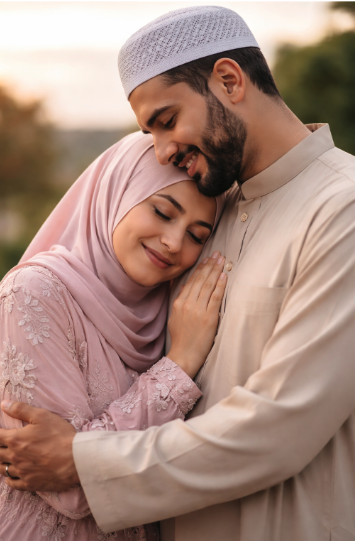
Marriage is not meant to be free of conflict. It is meant to be a place where conflict is handled with intention and mercy. From a Shia Islamic worldview, conflict is not a failure of the relationship; it is a test of akhlāq (character), niyyah (intention), and commitment to justice.
Imam Ali (p) is reported to have said:
“Allah has made jihad (self-struggle) obligatory upon both men and women. The jihad of men is to offer their wealth and their lives in the way of Allah. The jihad of women is to exercise patience in the hardships she faces from her husband and from his protective jealousy (ghīrah).” [1]
This narration acknowledges that struggle within marriage is real. For many men, struggle often shows up in providing for the family and handling responsibilities, while for many women, it may appear as emotional labor and navigating the challenges of daily life together. Both types of struggle carry spiritual significance. These experiences are not fixed. Sometimes women take on the primary financial role, or men navigate emotional and relational challenges at home. The important point is that both partners face meaningful struggles that shape and strengthen the marriage.”
Modern research confirms this insight. A study from the University of Tennessee at Knoxville shows that even happy couples experience frequent disagreements [2]. What sets satisfied couples apart is how they handle conflict. This approach reflects the guidance of Islam:
“And among His signs is that He created for you spouses from among yourselves so that you may find tranquility (sukūn) in them, and He placed between you affection (mawaddah) and mercy (raḥmah).”
(Qur’an 30:21)
Islam recognizes human vulnerability and describes the marital home as a place of comfort, love, and emotional refuge. It is meant to soften the hardships of life.
Core Conflict Resolution Skills
1. Gentle Start-Ups (Intention Before Reaction)
In everyday marriage, conflict often begins with something small: dishes left in the sink, a comment taken the wrong way, or a forgotten responsibility. What determines the outcome is not the issue itself, but the opening of the conversation.
Gottman research shows that the way a conflict begins predicts its outcome in over 90% of cases. Harsh criticism, sarcasm, or blame increases defensiveness and escalation, while respectful openings promote cooperation and listening.
A gentle start-up includes:
Stating concerns without accusation
Using respectful tone and language
Beginning with shared concern for the relationship
Our 6th Imam (p) was reported to have said, "Anyone who has no control over their anger has no control over their intellect." {AL-Kafi, Volume 2, P.g.303)
2. Building Shared Meaning and Value Alignment
Stable marriages cultivate a sense of shared meaning, common goals, values, and stories that give the relationship purpose beyond the day-to-day disagreements. Couples who frame conflict within higher principles (faith, family well-being, or ethical responsibility) tend to demonstrate greater resilience. In other words, they recognize that conflict often arises when the relationship deviates from the standards or ideals they hold sacred. By addressing these challenges thoughtfully and collaboratively, they are not merely resolving a disagreement, they are recalibrating the relationship toward the values and vision that give it lasting significance.”
The Messenger of Allah (ṣ) said: “There is no foundation in Islam more beloved to Allah than marriage.” [3]
When marriage is built on love, honesty, sincerity, and true faith in Allah, it becomes a structure that can withstand strain rather than collapse under it.
3. Emotion Regulation and Pausing
Gottman [4] emphasizes physiological self-soothing when conflict escalates. When heart rate and stress hormones rise, productive discussion becomes difficult. Taking a break allows emotional regulation and prevents harmful speech.
Imam Ali (p) is narrated to have said, “Anger is a vice that, when followed, causes destruction.” [5]
A time-out is not abandonment. It is a temporary pause to prevent damage. It should be used when one or both spouses feel emotionally overwhelmed and at risk of escalating into harmful speech.
Healthy time-outs include:
Agreeing that time-outs are allowed
Communicating clearly: “I know we need to talk about this, but I need to calm down first.”
Setting a time to return: “Can we talk again in 30 minutes?”
Using the break to soothe and reflect
Returning to repair the bond
Islamic practices for calming the self include:
Changing physical position (stand, sit, or lie down)
Performing wudhu
Seeking refuge in Allah
Dhikr and silence
Reciting Surah al-Imran, verse 134 - "Who spend [in the cause of Allah] during ease and hardship and who restrain anger and who pardon the people - and Allah loves the doers of good".
4. Respectful and Compassionate Communication
Respectful communication preserves the marital bond and prevents emotional injury. Gottman identifies contempt (mockery, sarcasm, superiority) as the strongest predictor of divorce. Replace contempt with:
Appreciation
Respectful tone
Emotional validation
Nonviolent Communication (NVC) developed by Marshall Rosenberg provides a helpful structure [6]:
Observation: “I noticed the dishes weren’t done this morning” not “You never help.”
Feeling: “I feel stressed and overwhelmed” not “You make me angry.”
Need: “I need help sharing responsibilities.”
Request: “Would you be able to do the dishes tonight?”
The Holy Prophet (pbuh&hp) is reported to have said, “The best among you is the one who is best toward his family, and I am the best among you to my family.”[7]
5. Thinking as “We,” Not “I”
The Qur’an says: “They are a garment for you and you are a garment for them.” (Qur’an 2:187)
A garment covers, protects, and preserves dignity. Publicly exposing private marital conflicts removes that garment. Gottman’s research shows couples who use teamwork language (“We need to figure this out”) experience:
Faster recovery
Lower hostility
Higher satisfaction
Repair After Conflict
Gottman defines repair as any attempt to reduce tension and restore connection. Long-lasting marriages are not those without injury, but those that heal quickly and make amends.
Repair includes:
Turning to Allah - “If they both desire reconciliation and peace, Allah will bring about harmony between them.” (Qur’an 4:35)
Apology without justification
Affection and reassurance
Restoring trust through visible effort and consistency
Trust returns when patterns are acknowledged, effort is seen, and commitments are kept.
When Conflict Escalates: When Is It Allowed to Tell Someone?
The Qur’an states, “And if you fear a breach between them, appoint two arbiters—one from his family and one from hers…”
(Qur’an 4:35)
Sharing conflict may sometimes be necessary when:
✔ There is harm or injustice
✔ There is risk of divorce
✔ Mediation is needed
✔ There is emotional or physical abuse
✔ You are seeking therapy or Islamic counseling
The role of mediators is not to take sides, but to restore balance and fairness while protecting dignity. Reconciliation succeeds not merely through technique, but through ikhlāṣ (sincerity).
Research shows that couples who engage in therapy often experience less marital stress and greater satisfaction, even when facing long-standing or recurring conflicts [8]. Programs that focus on improving communication, problem-solving, and emotional awareness are particularly effective. This approach aligns beautifully with Islamic guidance: seeking help is not a sign of weakness or failure, but a meaningful step toward nurturing a stronger, wiser, and more resilient marriage.
The Path Forward:
Conflict is an inevitable part of marriage. How you choose to respond is a choice. Will it be with blame or with intention? With silence or with repair? With ego or with mercy? Every couple can learn these skills. Every marriage can grow stronger through them. Start with one small step: speak softly, pause before reacting, and return with a heart full of sincerity. Tiny, consistent acts of care and patience are what rebuild trust and allow love to flourish.
1] Al‑Kāfī (Vol. 5, Book 1, Chapter 2). Retrieved from https://thaqalayn.net/chapter/5/1/2
2] University of Tennessee at Knoxville. (2019, September 16). How happy couples argue: Focus on solvable issues first. ScienceDaily. Retrieved January 28, 2026 from www.sciencedaily.com/releases/2019/09/190916114014.htm
3] Wasāil ash-Shī~a, volume 14, page 3
4] John Gottman’s research on couples spans over four decades and includes longitudinal studies of married couples, observing interactions in both laboratory and natural settings. He and his colleagues found that how couples handle conflict predicts long-term relationship success far more than the number of disagreements.
5] Ghurar al-Hikam wa Durar al-Kalim
6] Rosenberg, M. B. (2003). Nonviolent communication: A language of life (2nd ed.). PuddleDancer Press.
7] Wasā’il al-Shīʿa, vol. 20, p. 171
8] Shadish, W. R., Montgomery, L. M., Wilson, P. M., & Bright, I. (2020). Effects of behavioral couple therapy on marital satisfaction: A meta-analysis. Journal of Marital and Family Therapy, 46(2), 201–218. https://doi.org/10.1111/jmft.12409
